
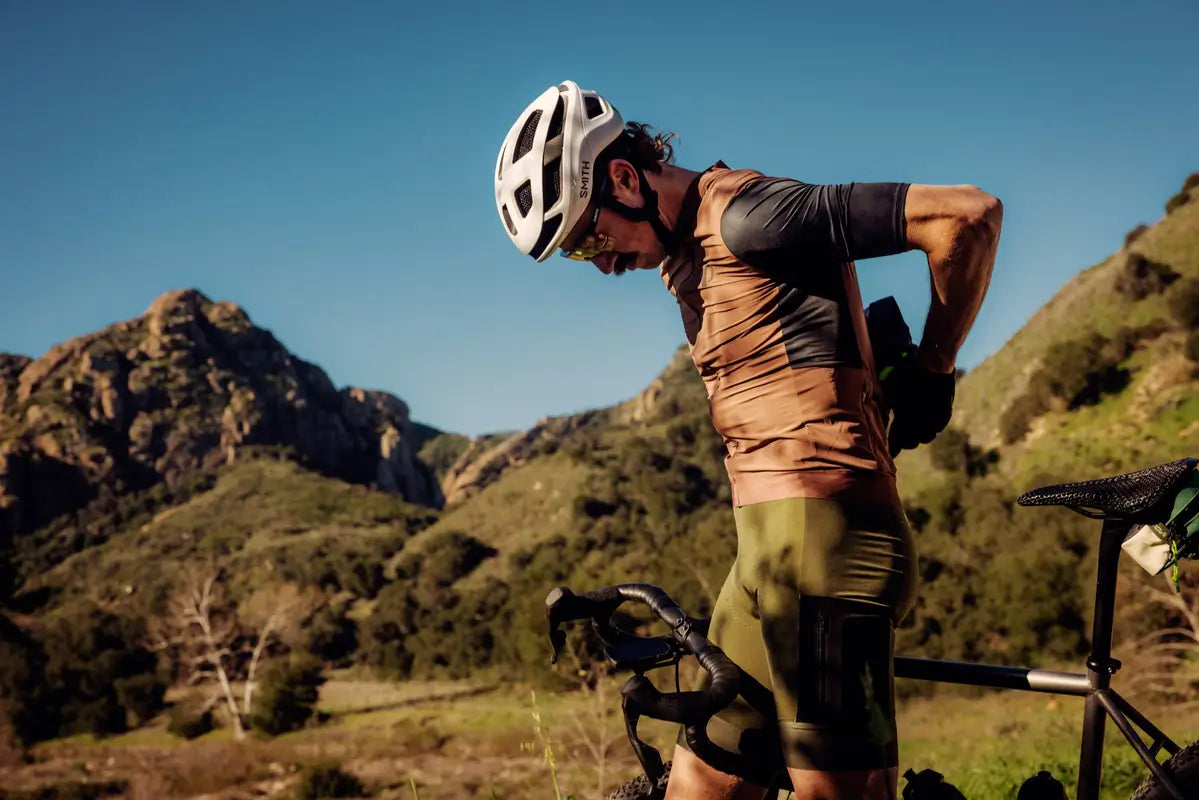
Gravel Bikepacking: The Apparel Guide for Riders Going the Distance
There's a moment on every gravel bikepacking trip, usually around hour six, somewhere between a sketchy descent and the next water source, when you realize your gear is either working with you or against you.
Out here, every chamois seam, every jacket pocket, every glove panel has a job to do. This guide covers the apparel system that touches you for fourteen hours straight — the one that decides whether day three feels like an adventure or a death march.
What Gravel Bikepacking Asks of Your Apparel
Gravel bikepacking sits in a weird middle space. You're not on a road, where you can call your partner if a kit fails. You're not mountain biking, where the rides are short, and the wash is waiting at home. It's long. It's exposed. It's almost always unsupported. Which means your apparel has to do three things at once:
-
Handle temperature swings of 30°F+ in a single day
-
Stay comfortable for 8–14 hours in the saddle
-
Survive being stuffed wet into a seatpack and pulled out the next morning to do it again
A jersey that breathes beautifully on a four-hour Saturday spin can chafe raw across the shoulder blades on day two. A chamois that's brilliant for 60 miles can feel like sandpaper at mile 90. PEARL iZUMi's Expedition Collection is built for these hours: versatile cargo storage, durable performance, and comfort to support every ride beyond the planned route.
The Bib Short Decision
If you take one thing from this guide, take this: The chamois that works for a four-hour ride is not the chamois you want for a four-day route.
Also, as you're assembling your bikepacking gear, look for gravel cycling bib shorts with:
-
Multi-density foam that doesn't pack flat under sustained pressure
-
3D shaping that holds structure hour after hour
-
A moisture-managing top sheet that performs even when you're soaked through
-
Cargo pockets on the thigh and lower back for snacks, salt tabs, phone, and tools
PEARL iZUMi Expedition Bib Shorts feature the dual-density ELITE Levitate 3D Chamois with a suspension core that dampens road chatter on rough surfaces. Stepping up, the Expedition PRO Bib Shorts use a triple-density PRO Levitate 3D chamois and Armourtech CORDURA® nylon for the rides that go deeper than most kits can handle.
Pro tip: Bring a second pair. Even on a two-day trip. Climbing back into yesterday's chamois on day two is the fastest path to a saddle sore that ends your trip.
Jerseys + Baselayers: The Engine Room
Your top half handles the most temperature variance. A 45°F gravel road at 6 a.m. and an exposed 85°F ridge at 1 p.m. is a totally normal day. You can't pack three jerseys for that. You pack a system.
-
Start with a baselayer. Counterintuitive but true: a good moisture-wicking baselayer keeps you cooler in heat (sweat moves off your skin faster) and dramatically warmer in cold (your jersey stays dry). Merino blends are bikepacking gold. They resist odor during multi-day trips when you're nowhere near a washing machine.
-
Layer a gravel jersey over it. A gravel cycling jersey, like our Expedition Short Sleeve Jersey, is built for exactly this use case: an ultra-light stretch-woven body that balances breathability with abrasion resistance, micro-mesh Transfer side panels for ventilation, and a five-pocket rear system (three bellowed + two zippered) that holds a day's worth of food and tools without bounce.
Outerwear: The Ride 365® Climate System Approach
Weather on a multi-day route isn't a single condition. It's a sequence.
PEARL iZUMi's Ride 365® Climate System is built around exactly this idea — interconnected layers across four core fabric technologies (Transfer, Barrier, Thermal, Softshell) that adapt as conditions shift, instead of one jacket trying to be everything.
The three workhorse pieces for bikepacking:
-
A packable wind layer. A lightweight gilet or barrier jacket that crushes into a jersey pocket. Goes on at every descent, comes off ten minutes into every climb. Speed of deployment matters more than premium fabric here.
-
A waterproof shell for serious rain. PEARL iZUMi's WxB® waterproof gear features seam-sealed construction and PI Dry® technology, a permanent, fiber-level water-shedding treatment that doesn't wash out the way standard DWR coatings do. On a bikepacking route where you usually can't wait out the storm, that durability matters.
-
A thermal piece. Long-sleeve thermal jersey or thermal tights for cold mornings and high-elevation evenings. PEARL iZUMi's thermal fabrics use lofted fibers that retain warmth while still evaporating moisture: non-negotiable if your route hits any elevation. For deep cold or extended winter trips, the AmFIB® Collection layers in three-layer windproof softshell construction.
The Small Things That Become Big Things at Hour 10
On a four-hour ride, a slightly off glove or a not-quite-right shoe is an annoyance. On day three of a bikepacking route, it's the thing you can't stop thinking about. These are the pieces most riders under-invest in, and the ones that quietly make or break a trip.
Gravel Cycling Shoes
Almost everyone is better off in a 2-bolt SPD setup for bikepacking. You'll walk hike-a-bike sections. You'll walk into gas stations. You'll walk around camp.
PEARL iZUMi's gravel cycling shoes are purpose-built for this overlap: stiff-yet-walkable composite soles, durable uppers, and lugged outsoles that grip when the trail goes vertical. Look for a shoe with a BOA® dial or similar micro-adjust closure (pressure points get amplified over multi-day mileage) and a reinforced toe box for the inevitable rock strikes.
Gloves
Bring two pairs if your trip hits both temperature extremes:
-
Lightweight, padded summer gravel gloves for hot days
-
A transition or thermal glove for early starts
Pro tip: Nerve compression from rough gravel is real. Targeted gel padding in the right zones beats thick foam everywhere.
Tights + Warmers
Thermal tights for cold mornings or removable arm and leg warmers, if your route's temperature range is moderate. Warmers pack tiny and let you regulate without changing shorts mid-ride.
Frequently Asked Questions: Gravel Bikepacking
How do I prevent saddle sores on a multi-day gravel bikepacking trip?
Four things, in order of impact: rotate dry bibs (bring two pairs, minimum), apply chamois cream and reapply at long stops, get fully off the bike at every break (don't just straddle the top tube), and use a multi-density chamois that holds shape over long hours. A flat pad compresses and creates pressure points by day two; a structured pad doesn't.
What temperature range should one apparel system cover?
For most US gravel routes, plan for a 35–40°F swing in a single day. A solid system covers roughly 40°F to 85°F by combining a baselayer, a gravel jersey, a packable wind layer, a thermal piece, and either thermal tights or removable warmers. High alpine sections (above ~8,000 ft) or shoulder-season rides need a seam-sealed waterproof shell on top of that.
Are MTB shoes OK for gravel bikepacking, or do I need dedicated gravel shoes?
MTB shoes work great. Many experienced bikepackers actively prefer them. A 2-bolt SPD MTB shoe gives you reliable engagement, walkable lugged soles for hike-a-bike, and durability for scrapes against rocks and chainrings. "Gravel-specific" shoes mostly bridge the stiffness of road shoes with the cleat pattern of MTB shoes.
How do you wash a cycling kit on a multi-day bikepacking trip?
Honestly? You mostly don't. A creek or campground rinse with biodegradable soap helps, but kits doesn't dry overnight in humidity. That's why two pairs of bibs is non-negotiable, why merino baselayers earn their cost (odor resistance across days), and why experienced bikepackers prioritize rotating dry chamois over deep-cleaning anything mid-trip. Plan your kit count around the longest you'll go between dryers, not sinks.
Do I really need cargo bibs, or are jersey pockets enough?
You technically don't need them. But riders who try cargo bibs almost universally don't go back. Jersey pockets work fine until the gravel gets chunky and everything bounces, or until you add a hydration vest that covers the pockets entirely. Cargo pockets sit on thighs and lower back, stay accessible under any layering, and don't bounce because they're compressed against your body. For self-supported days when you're pulling snacks every 20–30 minutes, the time savings add up.
